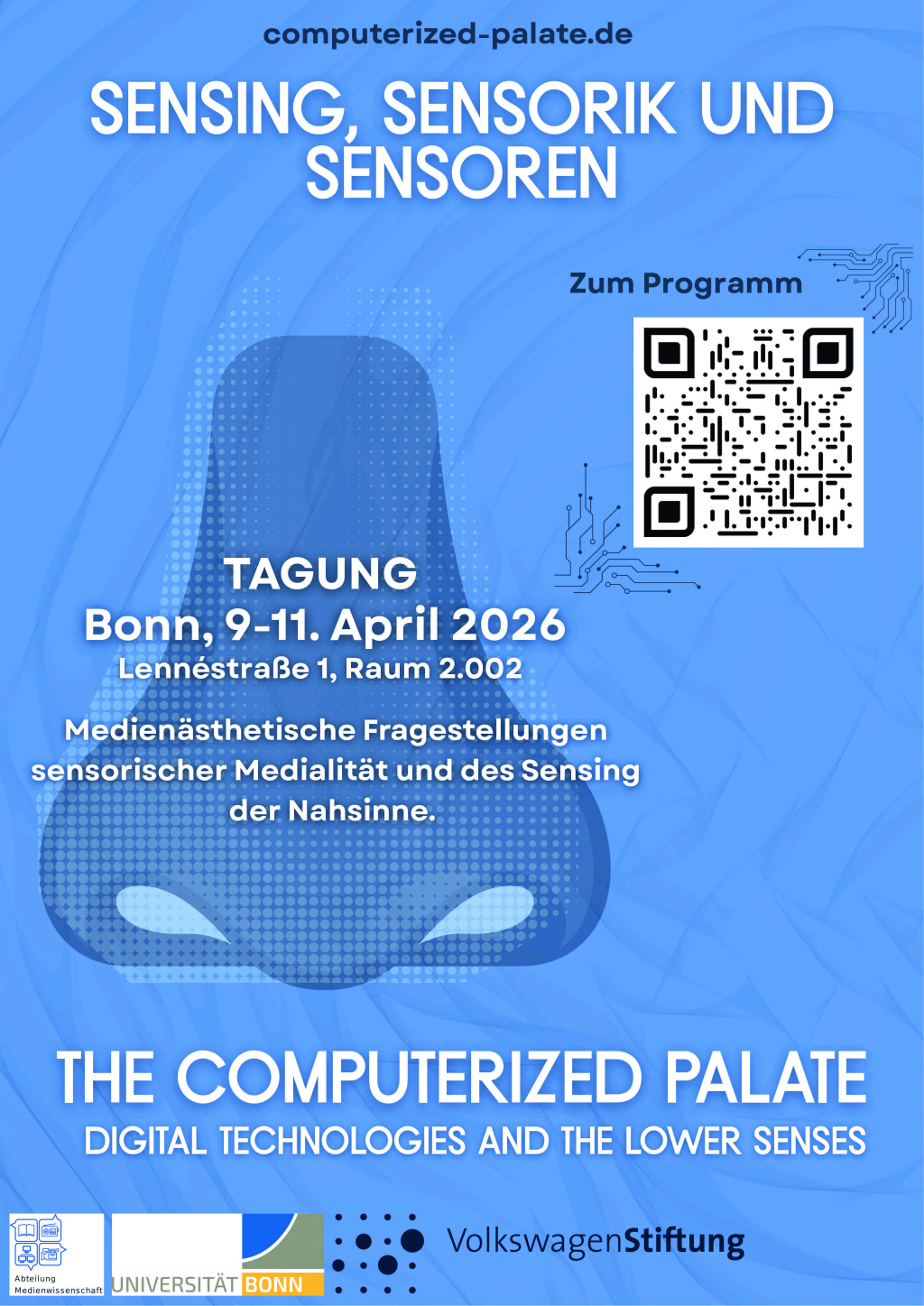
COMING SOON... 9-11.4.2026: SENSING, SENSORIK UND SENSOREN
Conference of the Volkswagen-Project »The Computerized Palate. Digital Technologies and the Lower Senses«
The ways through which humans interact with their environment via sensory perception is changing rapidly in the age of digital sensor technologies. An increasing number of technical sensors are currently being added to our skin, eyes, and ears – the once central interfaces between body and world. These sensors aim not only to imitate human smelling and tasting in addition to haptic and visual perception but also to translate smelling and tasting into digital processes—that is, into mathematically representable discrete operations. This brings a previously marginal dimension of media theory into focus: the entanglement of the “lower” senses with machine perception apparatuses, like sensors.
This development is not merely an expansion of the concept of the interface; it also touches on fundamental anthropological and epistemological questions—for example, concerning the boundary between human and nonhuman agency or the (technical) conditions of perception itself. Human and nonhuman operations appear to intermingle fluidly in this sensory situation. The relations of human-computer interaction (HCI) are renegotiated through questions about the “senses” and the purpose of sensors.
The sensing activated by sensors is part of a media-technical configuration of perception: sensors act not only as part of a media ensemble but increasingly extend the constitution of what can be considered perceptible. This coupling of human senses and technical infrastructures shifts human-computer interaction and transforms the interface from a mere point of contact into a sensory infrastructure in which data streams, materiality, bodies, and software form relational assemblages. Sensing thus serves paradigmatically as a renegotiation of the interfaces between humans, technology, and environment. This implies that not only the concept of the interface is expanded, but also the conditions and limits of perception are redefined in an increasingly sensor-mediated world.
The workshop Sensing, Sensorik und Sensoren
Medienästhetische Fragestellungen sensorischer Medialität und des Sensing der Nahsinne examines the entanglements of perception, media technology, and aesthetics in the context of sensory cultures. The focus is on theoretical and methodological approaches to processes of sensing as epistemic and aesthetic practices that mediate between human sensory perception, environments, and technical sensors. Media-aesthetic, cultural-technical, and material-theoretical perspectives on sensory mediality will be discussed in order to reassess the role of the near senses—especially smell and taste—in contemporary media dispositifs.
The goal of the workshop is to open an interdisciplinary discussion on the current relevance of the sensory and to explore the theoretical applicability of the term “sensing,” both in relation to digitalization—for example, of culinary experiences—and regarding the development of a mediality of the lower senses.
The ways through which humans interact with their environment via sensory perception is changing rapidly in the age of digital sensor technologies. An increasing number of technical sensors are currently being added to our skin, eyes, and ears – the once central interfaces between body and world. These sensors aim not only to imitate human smelling and tasting in addition to haptic and visual perception but also to translate smelling and tasting into digital processes—that is, into mathematically representable discrete operations. This brings a previously marginal dimension of media theory into focus: the entanglement of the “lower” senses with machine perception apparatuses, like sensors.
This development is not merely an expansion of the concept of the interface; it also touches on fundamental anthropological and epistemological questions—for example, concerning the boundary between human and nonhuman agency or the (technical) conditions of perception itself. Human and nonhuman operations appear to intermingle fluidly in this sensory situation. The relations of human-computer interaction (HCI) are renegotiated through questions about the “senses” and the purpose of sensors.
The sensing activated by sensors is part of a media-technical configuration of perception: sensors act not only as part of a media ensemble but increasingly extend the constitution of what can be considered perceptible. This coupling of human senses and technical infrastructures shifts human-computer interaction and transforms the interface from a mere point of contact into a sensory infrastructure in which data streams, materiality, bodies, and software form relational assemblages. Sensing thus serves paradigmatically as a renegotiation of the interfaces between humans, technology, and environment. This implies that not only the concept of the interface is expanded, but also the conditions and limits of perception are redefined in an increasingly sensor-mediated world.
The workshop Sensing, Sensorik und Sensoren
Medienästhetische Fragestellungen sensorischer Medialität und des Sensing der Nahsinne examines the entanglements of perception, media technology, and aesthetics in the context of sensory cultures. The focus is on theoretical and methodological approaches to processes of sensing as epistemic and aesthetic practices that mediate between human sensory perception, environments, and technical sensors. Media-aesthetic, cultural-technical, and material-theoretical perspectives on sensory mediality will be discussed in order to reassess the role of the near senses—especially smell and taste—in contemporary media dispositifs.
The goal of the workshop is to open an interdisciplinary discussion on the current relevance of the sensory and to explore the theoretical applicability of the term “sensing,” both in relation to digitalization—for example, of culinary experiences—and regarding the development of a mediality of the lower senses.


